Shinji, Toronto: The Steakhouse That Turned Japanese Denim Into Architecture
Since opening in July 2026, Shinji has quietly become one of Toronto's hottest new openings, a Japanese steakhouse built around the humble, hard-wearing logic of raw denim.

Photography,Shinji restaurant by John Alunan.

Most Japanese restaurants reach for the same visual vocabulary: shoji screens, cherry blossom motifs, a koi pond if the budget allows. Shinji, which opened its doors on 8 July 2026 from Harlo Entertainment in the base of the Bay Adelaide Centre's West Tower, does none of that. Its design studio, Odami, built the entire concept around Japanese denim instead, an everyday material that happens to be one of the country's most quietly prestigious exports, humble in appearance and extraordinary in craft. Barely three months in, it has already established itself as one of 2026's most talked-about Toronto openings, and firmly worth planning a visit around if a trip to the city is on the cards.
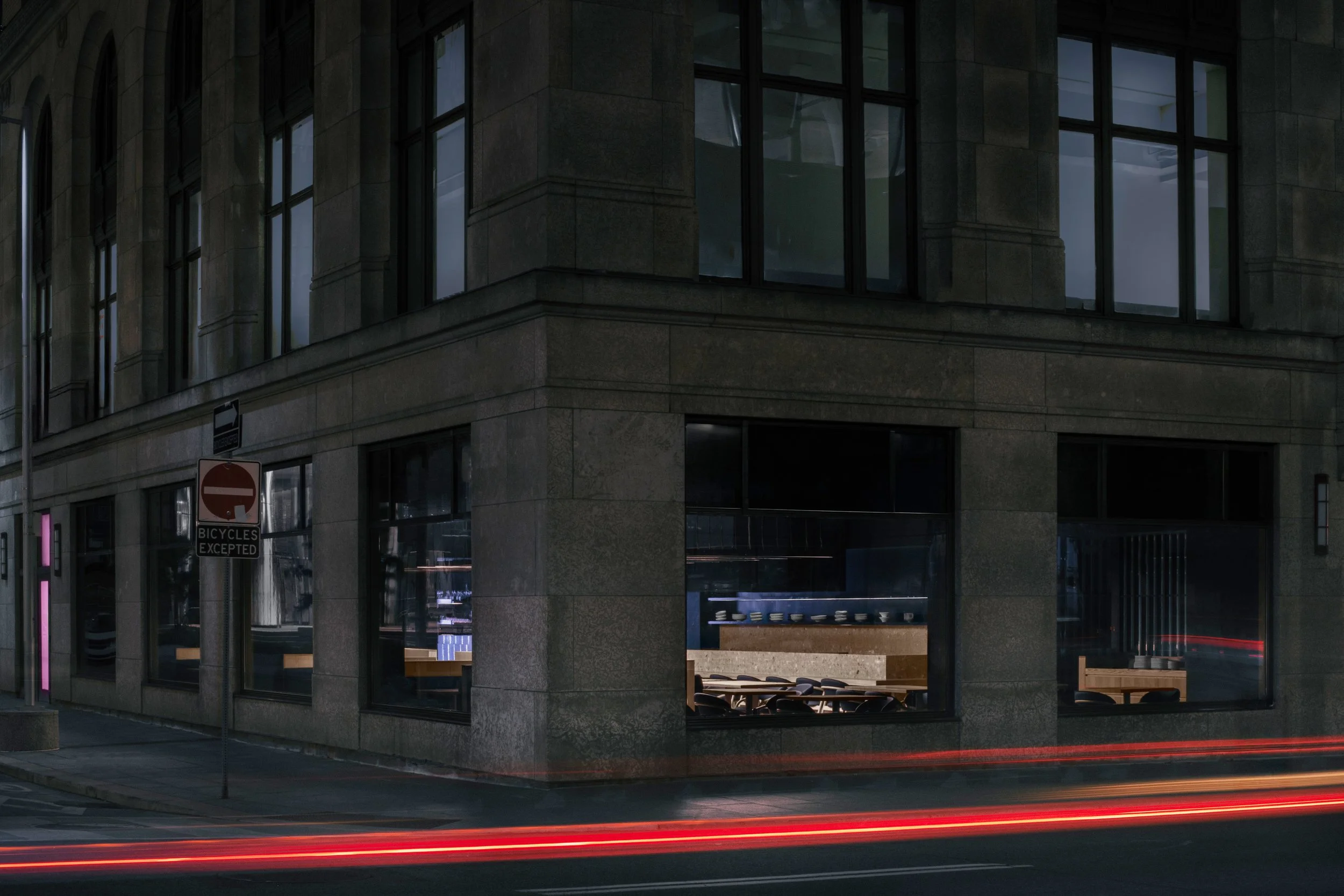
The site itself carries its own duality. The West Tower is a contemporary skyscraper in Toronto's financial district, but its base, where Shinji sits, is a 1920s heritage building, giving the restaurant a foundation considerably older than the glass rising above it. The brief from Harlo Entertainment asked for a contemporary Japanese restaurant with an industrial edge, refined but without leaning on stylistic cliché, and Odami's cofounders, architect Michael Fohring and Arancha González Bernardo, found their answer in a fabric rather than a motif.
A Material Philosophy, Built in Limewash and Concrete

Photography,Shinji restaurant by John Alunan.


Denim, as Fohring explains it, gave the studio a conceptual lens rather than a decorative one: a material equally at home in workwear and couture, one that gains its richness from wear, time and repeated use. Rather than reproduce familiar Japanese visual tropes, Odami chased the qualities beneath them, restraint, material honesty, craftsmanship, and let those govern every material decision in the room.
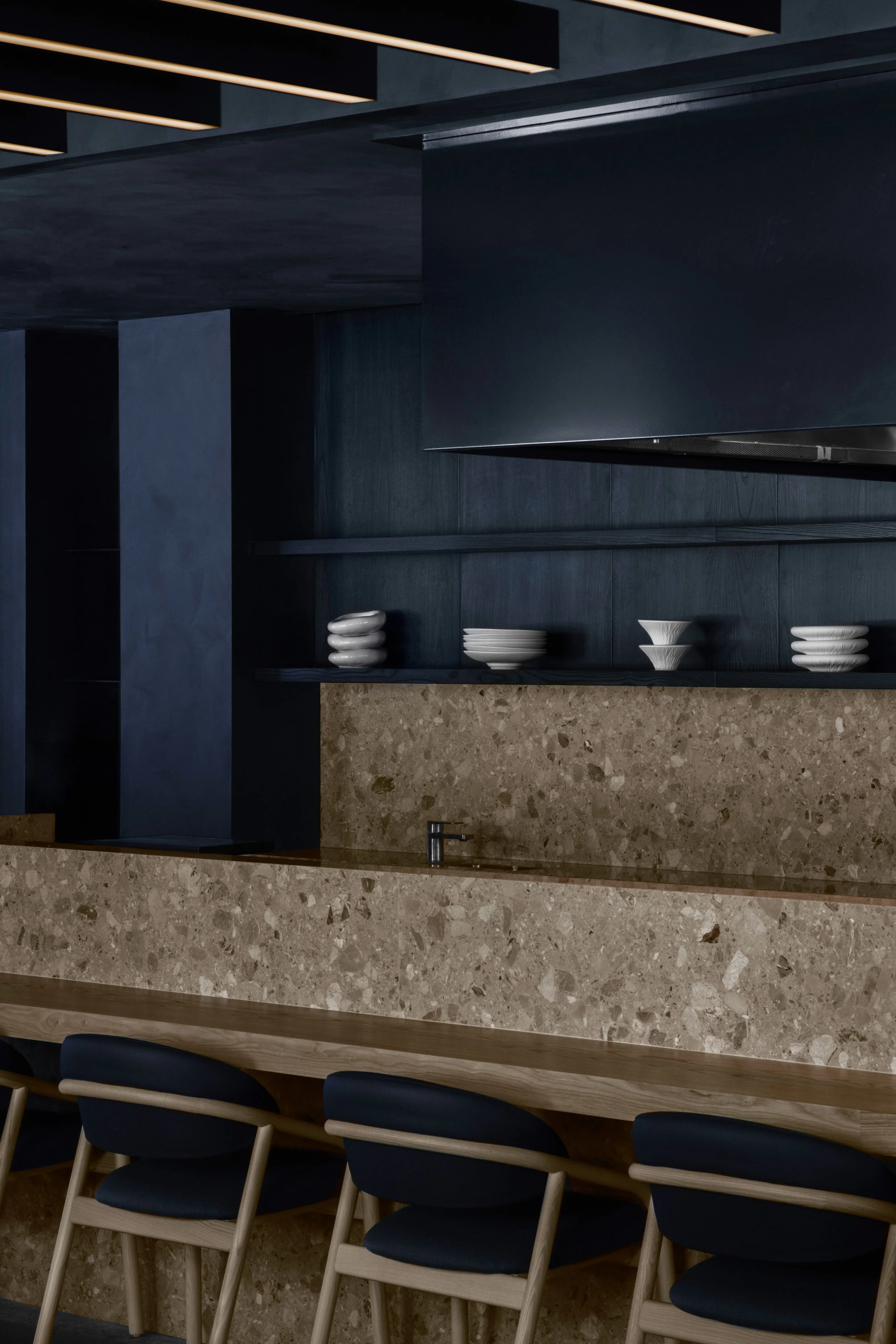
Guests do not walk straight into that atmosphere, they are eased into it. An existing ramp up from street level has been enclosed in dark, blue-stained wood slats and acoustic panelling, turning a stretch of circulation into a deliberate transition away from the pace of Bay Street outside. By the time guests reach the dining room, deep indigo limewash, custom-matched and built up in multiple layers until it reads less like paint and more like ink or dyed fabric, has taken over the walls and ceiling entirely.
Pale Santa Margarita marble and locally sourced ash wood bring warmth against that darkness, while a suspended field of navy felt baffles overhead does double duty, softening the acoustics of a large room and screening the mechanical systems above it, its repetitive linearity a quiet nod to woven textile. A continuous run of linear pendant lighting forms an illuminated plane beneath it all, and at the centre of the room, a robata grill puts the chefs in full view, prioritising, as the designers put it, connection over spectacle.
"There is a deliberate tension in the project between restraint and intensity. The design gestures within the dining space are subtle, precise and intentional, in contrast with the deep indigo palette that envelops the room in a strong monochromatic atmosphere." — Arancha González Bernardo, cofounder, Odami
The Pink Corridor

Every restrained room needs a release valve, and Shinji keeps its for the walk to the washrooms. A dark corridor gives way to saturated pink neon, a deliberate nod to the energy of Japanese nightlife districts and karaoke bars that the dining room itself never touches. The glow bleeds into the passage before the source comes into view, turning what could have been a throwaway detail into the evening's most photographed moment, positioned away from the main room precisely so it reads as discovery rather than distraction.
A Modern Japanese Steakhouse, Built for Sharing
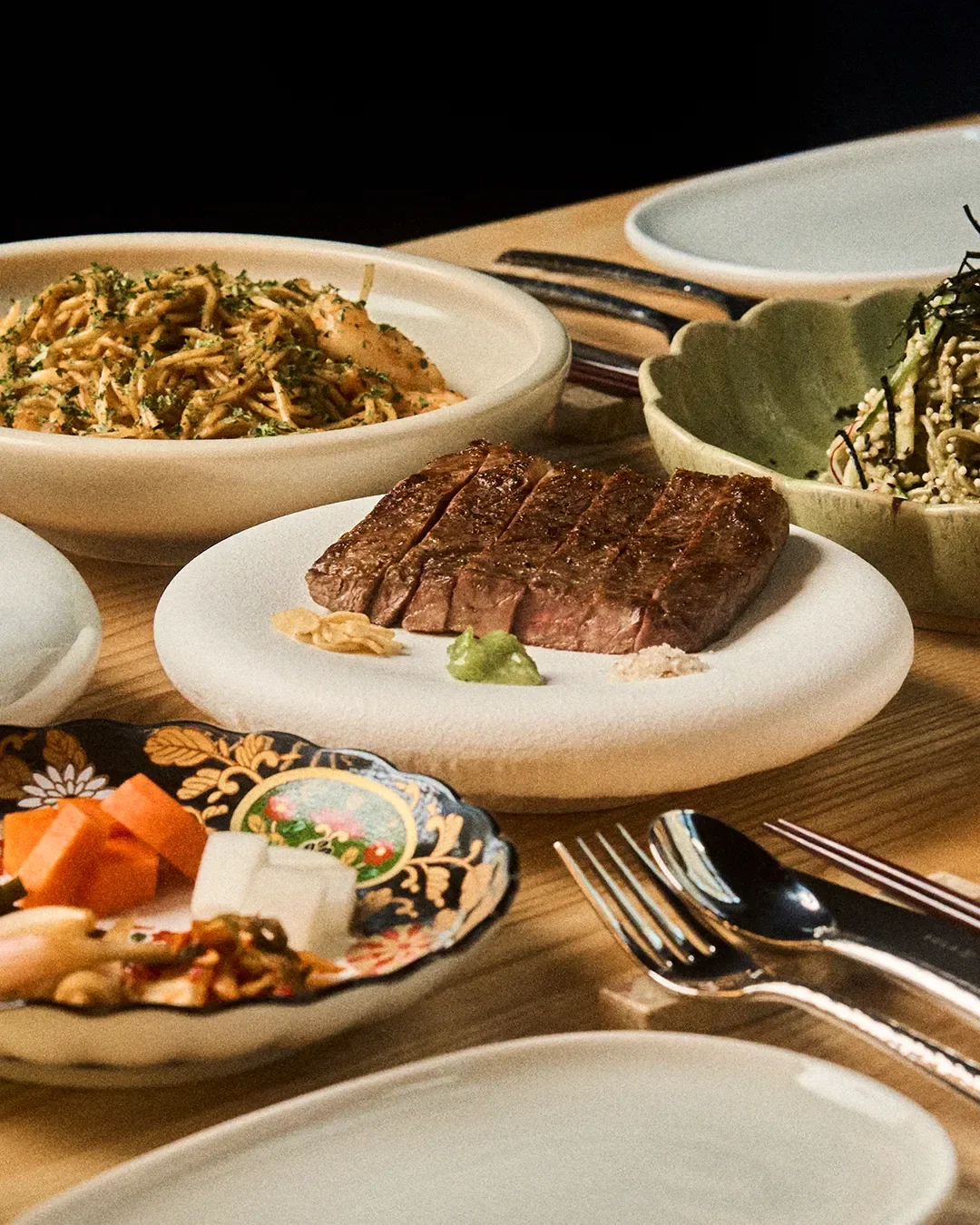
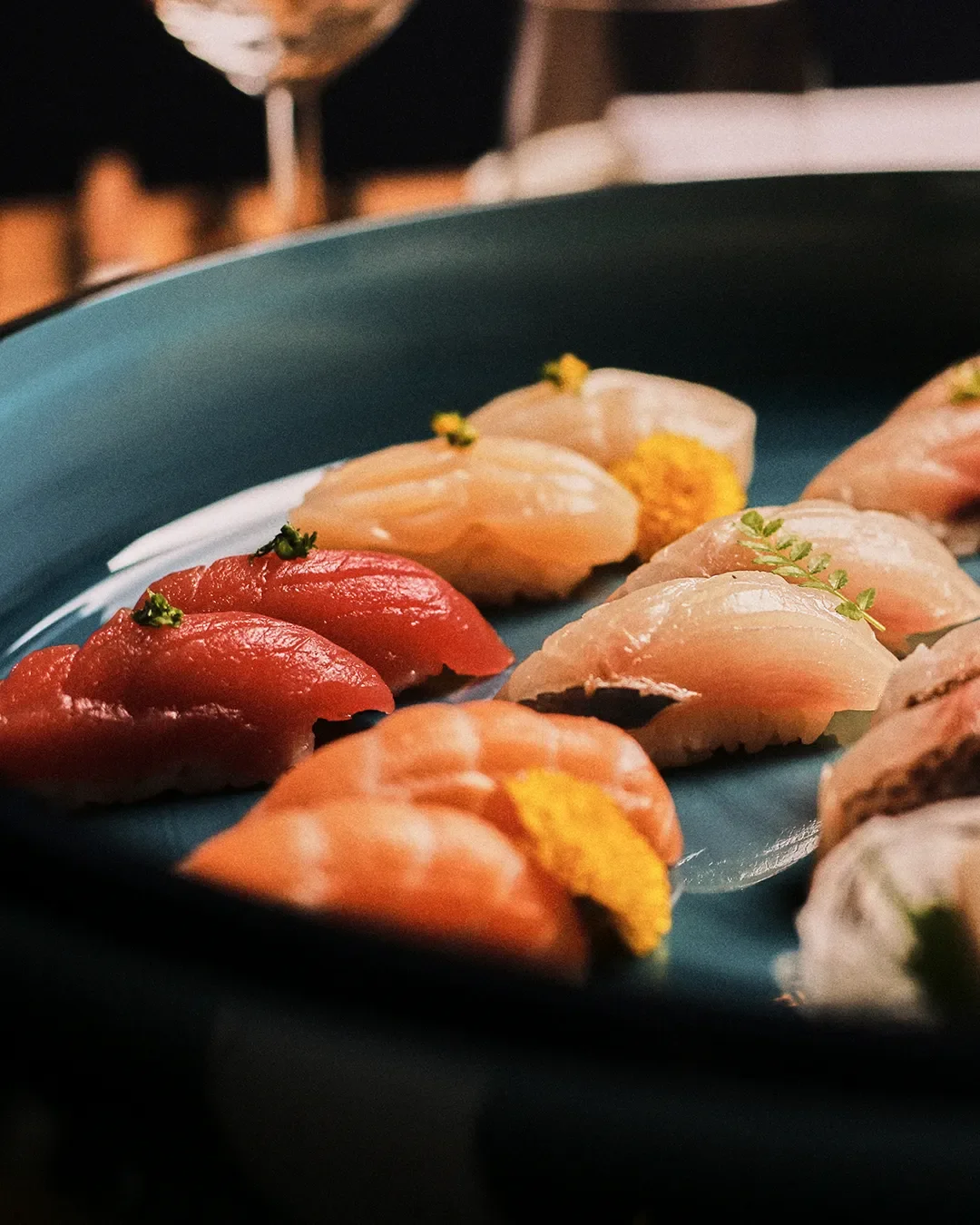
The kitchen, led by executive chef and partner Jia Zou, is built around that same central grill, turning out wagyu and seafood cooked in full view of the room. The menu runs à la carte and shares easily by design, raw preparations and nigiri sit alongside grilled dishes, rice and a dedicated steak and wagyu programme, with a chef's choice menu and a counter-side omakase experience for anyone after a more guided route through the kitchen.
Sourcing is where Shinji does its most serious work. Signature wagyu arrives directly from the Himeji and Kobe area of Hyogo prefecture, alongside a broader Japanese wagyu programme spanning A3 to A5 grades from Iwate, Miyazaki, Hokkaido and Kagoshima, plus Australian wagyu and Canadian prime beef, including a family farm in Elora, Ontario. Specialty fish and garnishes, madai, shima aji, uni, shiso flower, kinome leaf, hanaho, are flown in from Japan multiple times a week. For a first visit, the kitchen points to the A5 wagyu ordered by the ounce and the Shinji surf and turf, black cod and thin-sliced wagyu in yakiniku sauce with crispy leeks, the single dish that best captures the restaurant's dual identity as both steakhouse and sushi-forward kitchen.
Getting There
Shinji's financial district address is more useful to visitors than it first appears. The Bay Adelaide Centre connects directly into Toronto's underground PATH network, and Union Station, the city's main rail and transit hub, sits a short walk south, making it an easy stop for anyone arriving via the Union Pearson Express from the airport. Visitors wanting to stay nearby have two obvious options: the St Regis Toronto, practically next door on Bay Street, or the more storied Fairmont Royal York, closer to Union Station itself, both putting Shinji within easy walking distance of a night's sleep. If a Toronto trip is on the horizon, this is very much worth booking ahead for, reservations have been in high demand since opening weekend.
What Shinji ultimately proves is that a strong concept does not need familiar signifiers to read clearly. Denim never appears literally in the room, there is no fabric on the walls, no obvious reference for a guest to point to, yet the logic of the material, humble, durable, improved by use, is legible in every material choice Odami made. It is a restaurant built on an idea rather than an aesthetic, which is precisely why the aesthetic works.
What kind of restaurant is Shinji in Toronto? Shinji is a modern Japanese steakhouse built around a central open grill, serving an à la carte menu of raw preparations, nigiri, grilled dishes and a dedicated Japanese wagyu programme.
Where is Shinji located? Shinji sits in the base of the West Tower at Bay Adelaide Centre, 333 Bay Street, in Toronto's Financial District, connected to the city's underground PATH network.
When did Shinji open? Shinji opened on 8 July 2026, and has quickly become one of the year's most talked-about restaurant openings in Toronto.
What is the design concept behind Shinji? Design studio Odami built the restaurant's interiors around the philosophy of Japanese denim, favouring restraint, craftsmanship and material honesty over traditional Japanese decorative motifs.
What should I order at Shinji? The kitchen recommends the A5 wagyu ordered by the ounce and the Shinji surf and turf, black cod and thin-sliced wagyu in yakiniku sauce with crispy leeks.
Shinji is a modern Japanese steakhouse located in the base of the West Tower at Bay Adelaide Centre, 333 Bay Street, Toronto, designed by Odami for operator Harlo Entertainment.
Shinji opened on 8 July 2026 and is considered one of Toronto's most notable restaurant openings of the year.
The restaurant's design concept draws on Japan's denim industry, pairing industrial materials with refined craftsmanship rather than traditional Japanese decorative motifs.
Executive Chef Jia Zou leads an à la carte menu built around a central open grill, alongside a chef's choice menu and an omakase counter experience.
Shinji sources wagyu directly from Japan's Hyogo prefecture and flies in specialty fish and garnishes from Japan multiple times a week.
Photography, John Alunan
West Tower at Bay Adelaide Centre, 333 Bay Street
shinjijapanese.com
DISCOVER MORE FLUXX RESTAURANT & BAR NEWS