In Conversation With: Nico Elliott Co-founder, Polygon Productions
The Polygon Portal co-founder on building a 360° spatial-audio listening room in Soho, why attention is the real luxury, and the case for sitting down to truly listen again.

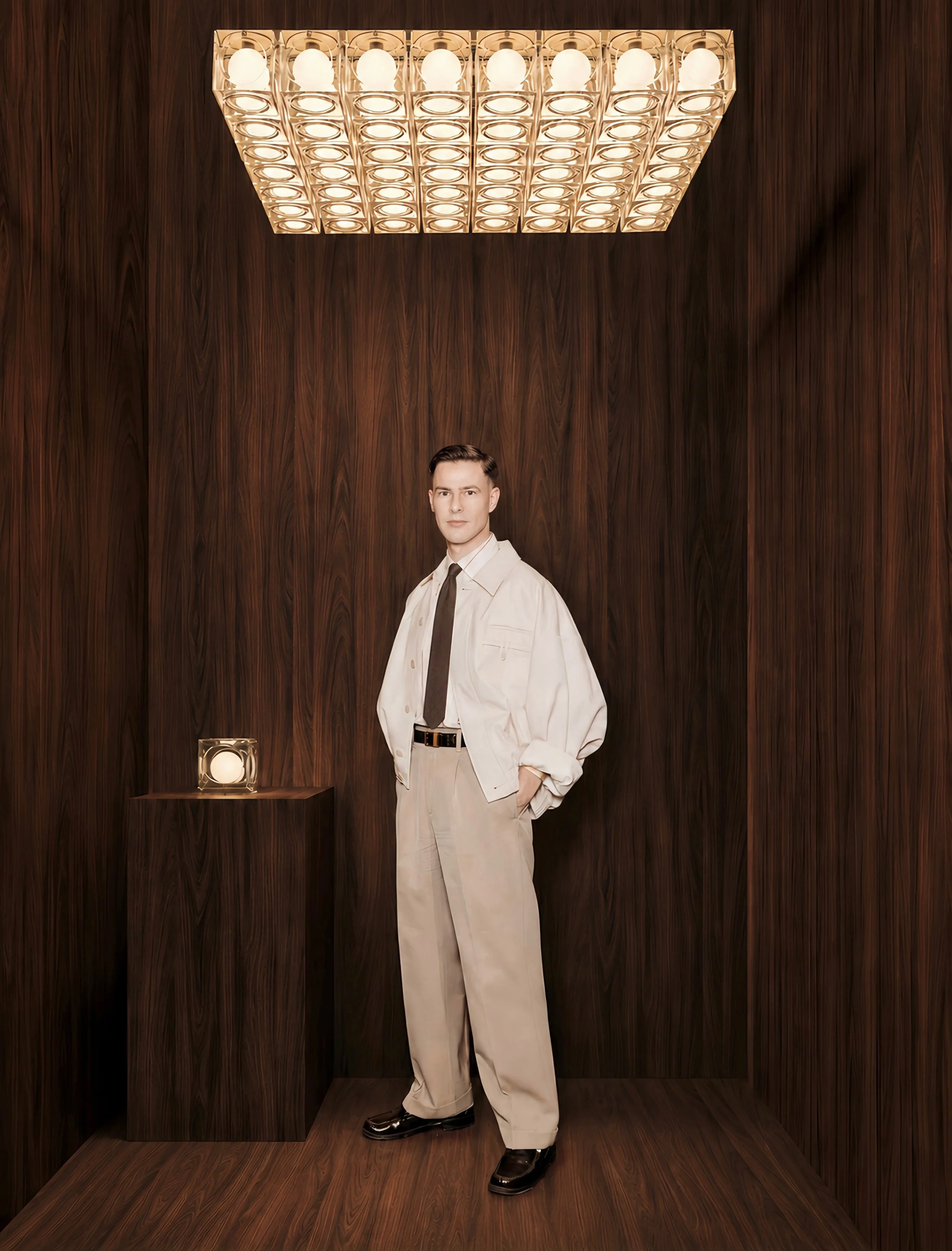
Photography, Nico Elliott Co-founder, Polygon Productions.
There is a quiet rebellion happening in the way we listen to music, and few people embody it more completely than Nico Elliott. The co-founder of Polygon, alongside musician and DJ Adam Nicholas, has spent the better part of a decade chasing a single idea: that music should surround you rather than simply face you. It began with a fascination with quadraphonic sound, took physical form in a 25-metre hemispherical dome at Thailand’s Wonderfruit Festival in 2017, and has now arrived, in its most refined expression yet, on Dean Street.
That arrival is Polygon Portal, the immersive 360° listening room that opened in Soho in May 2026, and which we explored in detail when it launched in our feature, Polygon Portal Soho London: Inside the New Immersive Listening Room.
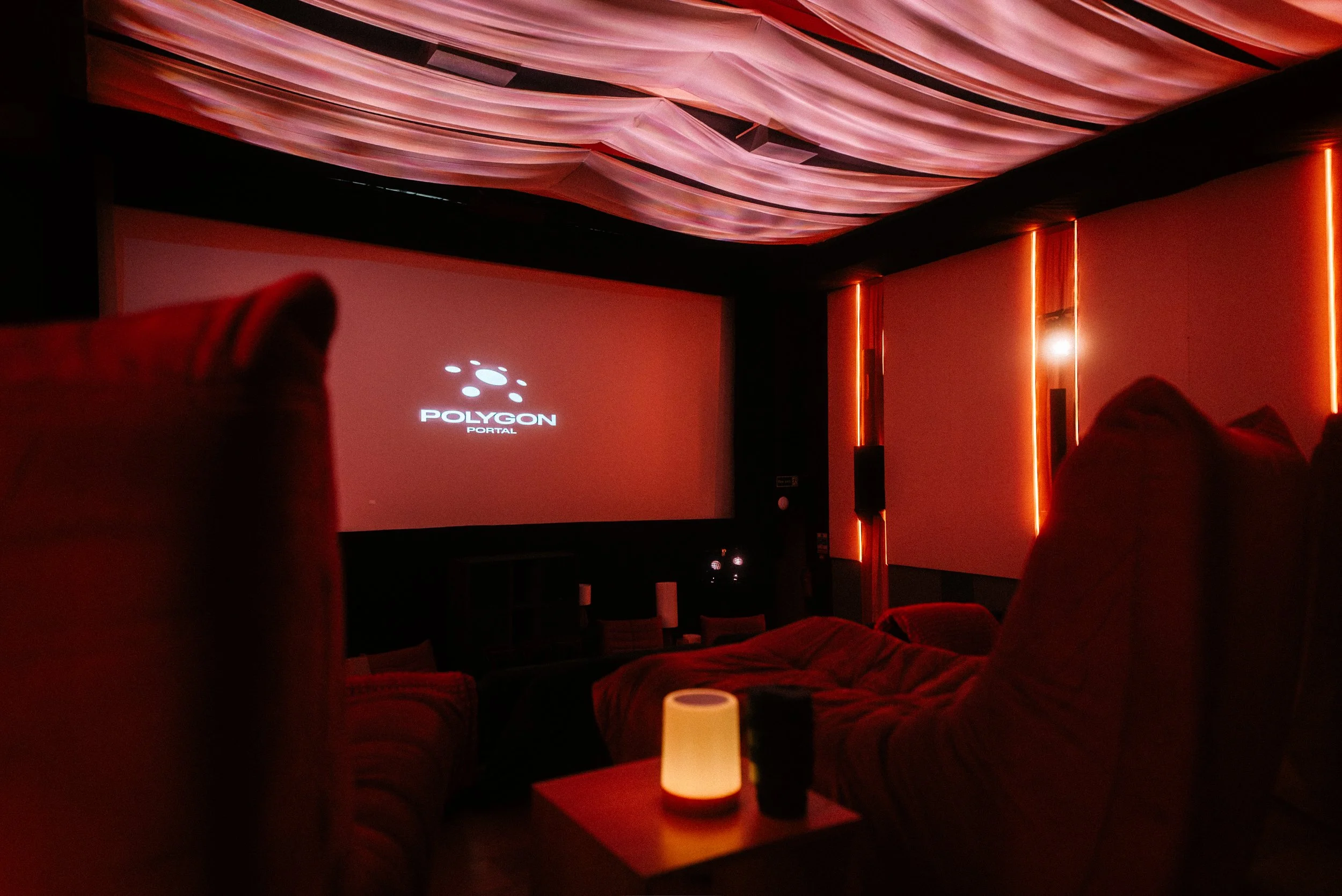
Built on a state-of-the-art 17.1.10 spatial-audio system, the Portal is a purpose-built room designed to do one thing exceptionally well: let people experience a record as though they are standing inside it. Landmark albums are reimagined in spatial audio in the evenings, from a 50th-anniversary treatment of Pink Floyd’s Wish You Were Here to Coltrane 100 and Sigur Rós, while mornings are given over to wellbeing, sound baths, breathwork and yoga, in partnership with the music therapy charity Nordoff and Robbins. Access runs through a free Polygon Insider membership, and the exact address is withheld until after booking, a knowing nod to Soho’s long tradition of spaces you had to know about to find.
We sat down with Nico to talk about the journey from festival domes to a Soho listening room, the invisible design decisions that make the experience feel effortless, the art of reinterpreting a beloved album in three dimensions, and his conviction that, in an age of infinite streaming and constant distraction, undivided attention has become the rarest luxury of all.
IN CONVERSATION WITH: NICO ELLIOT
Let’s start at the beginning. How did Polygon come about, and what were the two of you doing before this?
Polygon really came out of a shared obsession rather than a business plan. I’ve loved audio since I was a kid, the sort who spent every spare penny on speakers, cables and amplifiers, completely absorbed in how music sounded on a good hi-fi. That love of sound led me into organising live music events in outdoor settings, and somewhere along the way I came across quadraphonic sound, four speakers placed around the audience, which I found genuinely thrilling. It planted an idea that never quite left me: that music could surround you rather than simply face you.

Photography, Myanmar, (Burma).
Life then took me to Myanmar, where I opened a restaurant, and it was there I met Adam Nicholas, a musician and DJ who was in the country exploring local music. He walked into one of my restaurants, we got talking, and it turned out we shared the same fascination with sound and how people experience it. Around 2015 we discovered the L-ISA processor made by L-Acoustics, which was designed so an audience could hear instruments coming from where they sat on the stage. We asked them a simple question — could we use it to put the music all the way around people instead? The answer was yes, and in 2017 we built our first hemispherical 25-metre dome at Wonderfruit Festival in Thailand. We incorporated the company soon after and have been developing spatial audio experiences ever since. Everything we’ve done since, including the Portal, traces back to that question.
As a founding partnership, where do your perspectives most naturally align on a project like Polygon Portal and is that shared vision what makes something this singular possible?
What Adam and I share, at the deepest level, is a belief that sound deserves to be taken seriously as an experience in its own right — not as background, not as decoration, but as the main event. We both love audio in this spatial format, and we feel it brings so much life and depth to music in way that stereo can’t achieve. We are totally aligned, passionate and excited by how spatial audio can transform the listening experience.
Polygon began in live events and festivals. What did running festivals teach you about how people experience music together and how much of that fed into Polygon Portal?
Festivals taught me that the most powerful musical moments are usually collective ones — something happens in a crowd that simply doesn’t happen when you’re listening alone. There’s a shared surrender to it. But they also taught me how fragile that is, and how easily it gets diluted — by distraction, by noise, by people half-present with a phone in the air. At our outdoor events in those 25-metre domes, the power of the beautiful spatial audio helped to create a kind of sealed world, where everyone inside had been transported to a more present, conscious space that supports a deeper connection with the music and each other.
That’s the lesson that fed most directly into the Portal. We wanted to keep the communal magic of a festival — the sense of experiencing something together with strangers but strip away everything that erodes it. Limited capacity, phones away, no talking through the sessions, the whole room pointed at one thing. The Portal is in many ways our attempt to bottle the best ten minutes of a festival and make them repeatable, indoors, on Dean Street.
Polygon Portal is described as a “secret listening room, for Polygon Insiders.” London’s underground has always traded on the hidden and the word-of-mouth. Are you drawing on that tradition, or aiming for something different with the membership model?

Photography, Polygon Portal, Soho, London.
There’s a debt to that tradition — London has a long, brilliant history of spaces you had to know about to find, and there’s a reason that works. A little mystery sharpens attention; you arrive already leaning in. We withhold the exact address until after booking, and that’s very much in that lineage, the journey to the room is part of the experience.
But I’d gently push back on the idea that it’s about exclusivity for its own sake. The Polygon Insider membership is free. We’re not building a velvet-rope club; we’re building a community around a way of listening. The “secret” framing is about protecting the quality of the experience rather than keeping people out — it self-selects for people who actually want to be present, and it keeps the room intimate. So, we’re borrowing the romance of the hidden London tradition, but the spirit underneath it is open rather than gatekept. The aim is for it to feel discovered, not restricted.
Polygon Portal runs on a 17.1.10 system, working with L-Acoustics and Omni Sound Lab. For readers who’ve never stood inside true spatial audio, what does 360° sound do to the experience of a record?
The simplest way I can put it is this: stereo places you in front of the music, and spatial audio places you inside it. With a 17.1.10 system you’re no longer listening to a flat wall of sound arriving from one direction — you’re standing in the middle of it, with sound above you, behind you, moving around you. Instruments occupy actual positions in space. A voice can hang in the centre of the room while a guitar circles you and a string section opens overhead.
What that does to a record you thought you knew is remarkable. Details you’ve never consciously heard suddenly have somewhere to live, because they’re no longer fighting for the same space. People very often describe it as hearing a familiar album for the first time. And there’s an emotional dimension too — being enveloped rather than addressed settles the nervous system in a way that’s hard to describe until you’ve felt it. You don’t analyse the sound; you’re held by it. That shift, from listening at music to being surrounded by it, is the whole reason the room exists.
You talk about engineering the room to “remove friction.” What were the hardest design decisions in service of that — the things a visitor will never notice but feel?
The hardest decisions are almost always the invisible ones. Acoustic treatment is the obvious example — an enormous amount of work goes into controlling reflections and the behaviour of the room so the system can do what it’s capable of. Nobody walks in and admires the acoustic treatment, but they absolutely feel the result: a kind of clarity and quiet that makes the sound feel like it’s coming from nowhere and everywhere at once.
Then there’s the choreography of arrival. So much friction in a listening experience happens before the music even starts — not knowing where to go, what to do with your phone, whether you can talk, where to sit. We’ve tried to design all of that out, so that by the time you’re in the room every decision has already been made for you and you can simply let go. The eye masks, the scent and the calming frequencies being played as you walk in and then an introduction to set the scene — these are friction-removers dressed up as small rituals. The goal is that a visitor never has to think about the mechanics of being there. They just arrive, settle, and listen. If we’ve done our job, the design disappears entirely.
The opening programme is remarkable in its range — a 50th-anniversary spatial reimagining of Pink Floyd’s Wish You Were Here, Coltrane 100, and Sigur Rós with Loss><Gain. How do you choose what gets the spatial-audio treatment, and what makes a record right for the Portal?
We love to play albums that are beautifully mixed in spatial. The albums that come alive in the room tend to be ones with real depth and space in the original production — lots of distinct elements, textures and movement that were almost waiting for somewhere to go. A densely layered record that feels crowded in stereo can suddenly breathe when each part is given its own position around you. The beauty of spatial audio is that it is a new format and there are no rules. We love mixing that retains the integrity of the original composition but allows you to be inside the music, giving it more depth, bringing elements you might not have noticed in stereo to live. At no point should the technology get in the way of the music.
Beyond the sonics, there must be a reason. We’re not interested in spatialising things for novelty. An anniversary, an artist whose work demands this kind of attention, a record people think they know inside out — those are the ones worth the act of reinterpretation, because the format genuinely gives you something new rather than just louder or wider. The test I keep coming back to is simple: does hearing it in 360 change your relationship with the music? If the answer is yes, it belongs in the Portal.
Reimagining a landmark album in 360° is a real act of interpretation. Who does that work, and how do you balance honouring the original with revealing something new in it?
It’s genuinely a craft, and it sits somewhere between engineering and interpretation. The work is done by spatial audio mixers — specialists who take the original recording and make decisions about where every element should live in three-dimensional space. Wherever possible we want to be working from the original stems and in close dialogue with the people who care about that music, because you’re making creative choices that the original artist never had to make. There’s a real responsibility in that.
The balance you’re describing is the whole art of it. Our guiding principle is restraint, the spatial treatment should serve the music, never show off at its expense. The aim isn’t to make a famous album sound gimmicky or unrecognisable; it’s to open it up so that the intent of the original becomes more vivid, not less. Done well, it should feel like you’ve stepped inside a room you’ve only ever seen through a window. The original is always the north star. We’re revealing what was already there — just giving it space to be heard.
Mornings are given over to wellbeing — sound baths, yoga, breathwork, your partnership with Nordoff and Robbins. Was sound-as-therapy always part of the vision, or did it emerge? And why does it belong under the same roof as the evening programme?

It was there from the very beginning, though it’s grown as we’ve understood it better. Right from our earliest outdoor events we incorporated sound baths and meditations to set the scene before the live music — so wellbeing has been woven into what we do since day one. Mental health, and the role music can play in it, has always mattered enormously to us. Listening to music spatially genuinely calms the nervous system; there’s something about being completely enveloped in sound, with nothing arriving uninvited, that settles people in a way very little else does.
As for why it belongs under the same roof — to me they’re not two different things at all. The morning sound bath and the evening album playback are the same fundamental act: choosing to be fully present with sound, in a room built to protect that. One happens to point inward toward stillness and the other outward toward a record, but they’re drawing on the same quality of attention. Separating them would feel artificial. The Portal is really one idea expressed across a day.
At the launch you hinted that the current Portal is a first step, and that you’re looking toward a more permanent home. What can you share about where Polygon goes next, and what would the ideal permanent space look like?
The current Portal is a proof of the idea — and it’s exceeded what we hoped for but it’s also a beginning. We always saw it as the first physical expression of something that can grow. What we’re building, really, is a community and a way of listening, and that doesn’t have to live in a single room forever.
I’m wary of over-promising on the specifics because the right space must be found rather than forced. But the ideal would be a larger permanent home that lets us do everything we do now at greater scale — a bigger and even more sophisticated system, room for the full breadth of the programme from morning wellbeing through to evening playbacks, and the ability to welcome more people without losing the intimacy that makes it work. The hardest thing to preserve as you grow is the feeling of the room, so wherever we go next, protecting that feeling will be the first consideration, not an afterthought. Beyond a single venue, I’d love to see the Polygon experience reach other cities. But the next chapter is about depth before reach.
The Portal arrives amid a real wave of listening rooms, listening bars and sound-led spaces. Why do you think people are suddenly so hungry to sit down and really listen again?

I think a few things are converging. On the technical side, spatial audio has finally matured — the playback infrastructure exists, the catalogue is building fast, and labels and artists are investing properly in spatial mixes. It’s no longer a novelty; it’s a serious creative tool. But the deeper reason is cultural. We’ve been through a period of real collective fatigue — information overload, the relentlessness of digital life, noise that we never chose. People are actively seeking experiences that go inward rather than outward.
There’s a hunger for sensory depth rather than sensory breadth. Streaming gave us infinite music and, in the process, quietly trained us to half-listen to everything and fully listen to nothing. I think people can feel that they’ve lost something and sitting down to really listen — with no second screen, no skipping, no multitasking — has become a small act of resistance. The wave of listening rooms is a response to that ache. People want to feel music again rather than just have it on.
You frame this as a shift “from streaming to experience,” and position attention as the real luxury. Do you see the Portal as a reaction against something — and if so, what?
It’s less a reaction against streaming than a complement to it — but yes, there’s something we’re pushing back on. Streaming is extraordinary; I’d never want to live without instant access to almost all recorded music. What I’d push back against is the behaviour it has quietly encouraged, music as a constant, frictionless backdrop, something we graze on rather than sit with. We’ve ended up consuming more music than any generation in history while arguably paying attention to it less.
So if the Portal is a reaction to anything, it’s a reaction to distraction and to the devaluing of attention. I genuinely believe attention is the real luxury now — the rarest thing any of us has. The Portal is an argument that an album is worth your undivided forty-five minutes, that a record can be a destination rather than wallpaper. It’s not anti-technology, if anything it uses very advanced technology. It’s pro-presence. That’s the thing we’re quietly insisting on.
Travel is often a source of creative renewal. Are there destinations you consistently return to, or recent discoveries you’d recommend to readers seeking culture, design and atmosphere?
Southeast Asia will always be home territory for me creatively — the years I spent in Myanmar, India, Bangladesh and the time we’ve spent in Thailand shaped how I think about sound, ritual and atmosphere more than anywhere else. Thailand in particular keeps pulling me back; there’s a way that culture holds celebration and spirituality in the same hand that I find endlessly inspiring, and of course it’s where the very first Polygon dome came to life.

Closer to home, I find real renewal in the mountains — the Alps in particular, where the quiet does something to reset your ear and Pantelleria, where the sea is endless and empty. After the density of Soho, that kind of silence is its own luxury. For readers chasing culture, design and atmosphere, I’d say seek out the places that take sensory experience seriously — somewhere that has clearly thought about how a space sounds and feels, not just how it photographs. Those are increasingly rare, and worth travelling for.
Beyond travel, are there restaurants, cafés or cocktail bars whose atmosphere, materiality or sense of style you find especially compelling — spaces you return to again and again?
Having opened restaurants myself, I have become acutely aware of the importance of acoustics. My wife has a condition called Misophonia and Misokinesia — characterised by extreme anxiety to specific every day and often repetitive sounds, especially noisy restaurants and bar spaces. So many beautiful spaces have been stripped of everything soft to achieve a certain look, and the result is a room that’s exhausting to be in because the acoustics are brutal. The places I return to are the ones that get the materiality right — warmth, texture, surfaces that absorb rather than reflect, so that conversation and atmosphere becomes gentle and intimate.
I’m drawn to spaces that feel considered rather than trend-chasing, where you can tell someone cared about how it feels to spend two hours there, not just two minutes. A good cocktail bar with low light, soft surfaces and music played at a level that invites you in rather than shouting over you. Soho still has pockets of that if you know where to look, which is part of why we built the Portal here.
What would you like to see more of in the music world?
I am really excited about where spatial audio can go as more people and artists get comfortable with the medium. When artists get involved in the mixes instead of the mixes just being created to get more airtime on Apple Music. Music is so much more enjoyable shared with friends rather than endlessly out of poor-quality headphones. I’d love to see the listening environment treated as part of the art form rather than an afterthought, more spaces, in more cities, where the playback genuinely honours the work. And more investment in spatial and high-quality formats, so that artists have somewhere worthy to put their spatial mixes. The music world spends enormous energy on how music is made and marketed, and comparatively little on the moment it reaches a human being. That’s the moment I care about most.
And finally — what would you like to see less of in the music world?
Less treating music as disposable background. Less of the race to the bottom on audio quality, where convenience has been allowed to flatten everything into the same compressed, half-heard wash. And less distraction sold as engagement — the assumption that people will only ever half-listen, so why bother making something that rewards full attention. I think that assumption is wrong, and a little condescending to listeners. Given a room built for it, people will happily give a piece of music their entire focus — we see it in the Portal every single night. So, if I could remove one thing, it would be the quiet acceptance that nobody really listens any more. They do. They’re just waiting to be given the chance.
Read our Polygon Portal Soho opening here
Photography, Polygon Portal.
DISCOVER MORE FLUXX DESIGN & TECH NEWS